


Clearing snow with the bucket you already own works, but is it the best way to get the job done?
Use a snow pusher for open areas where you can push snow straight to a designated pile. Use a snow bucket when you need to scoop, carry, relocate or load snow. If the regular bucket you already own handles your property, you may not need to buy either.
For skid steer owners, the decision comes down to the work you're doing, where the snow needs to go, and whether another attachment will actually save enough time to justify the purchase.
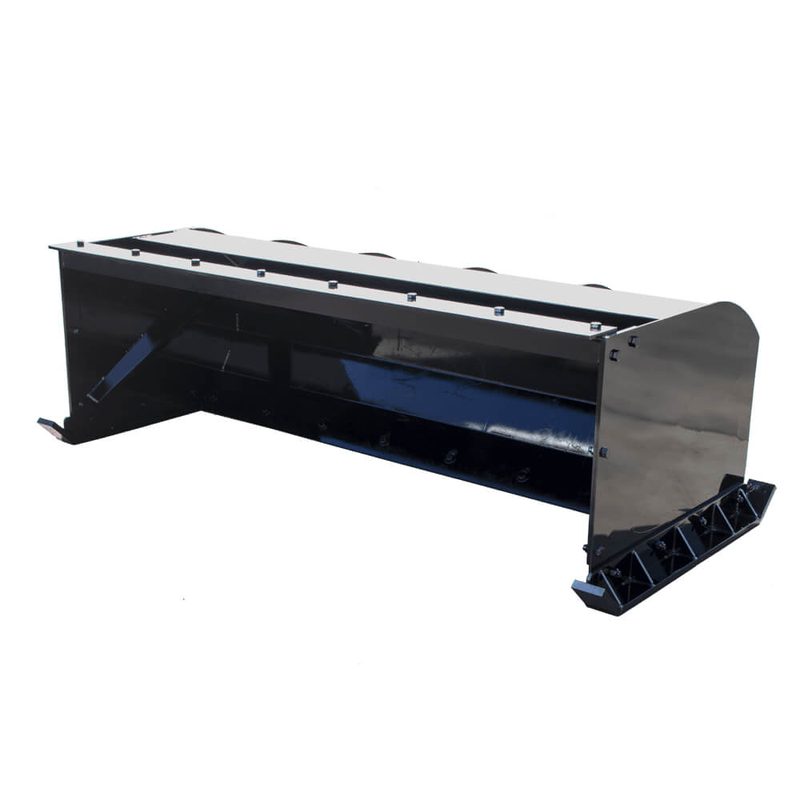

Three practical choices, depending on what you already own and how you move snow:
Best for: Small driveways, occasional snowfall and general property cleanup where you sometimes need to scoop or carry snow.
Limitation: It fills sooner than a high volume snow bucket and can leave snow spilling around the sides.
Another purchase? No, if the bucket you own already handles the work.
Best for: Carrying snow, stacking piles, loading trucks and clearing around buildings where you need more bucket volume.
Limitation: More volume also means more potential load weight, and you'll still stop to dump.
Another purchase? Yes. Compare options in our skid steer buckets collection.
Best for: Open lots and wide yards with a clear route to a designated snow pile.
Limitation: It can't scoop and carry snow, and growing loads eventually limit push distance.
Another purchase? Yes. Browse our skid steer snow pushers.
A snow pusher, also called a snow box, push box or containment plow, has a moldboard and side plates. Snow collects in front of the attachment as the skid steer pushes it along the ground. At the pile, the operator leaves the load and backs away.
A snow bucket has a bottom, side walls and a cutting edge. It can push snow along the ground, but it can also scoop a contained load, lift it, carry it elsewhere and dump it.
That's the fundamental tradeoff: A pusher handles accumulated snow without repeatedly filling and dumping a bucket. A bucket gives you the ability to lift and move snow away from the clearing route.

Don't confuse the amount of snow a pusher moves along the ground with a bucket's carrying capacity. A pusher can accumulate a large load without lifting its full weight. A bucket must remain within the skid steer's safe lifting capabilities.
Imagine clearing a wide commercial parking lot after an overnight snowfall. You've got relatively open pavement, a place to pile the snow and enough room for straight passes.
With a bucket, the attachment fills and snow eventually spills around the sides. You dump the load, back away and repeat. The small windrows left behind may require additional cleanup.
Cliff SEIA described that problem in a 2012 NewAgTalk discussion, noting the extra work caused by snow spilling around a bucket.
A snow pusher's side plates help keep that accumulating snow together. In a 2006 PlowSite discussion, commercial operator sharpercut recommended pushers for larger parking lots and buckets for cleanup work afterward.
For bulk clearing on open ground, the Glacier Heavy Duty Snow Pusher and Prime Snow Box are two options for larger clearing jobs when properly matched to the machine.
For smaller residential properties, acreage maintenance and occasional snow removal, the Storm Snow Pusher is another option. It is not positioned as a commercial snow removal pusher.
It can, especially when a regular bucket forces you to stop frequently to dump snow or clean up spillover.
In a 2010 PlowSite discussion, snowtech recommended a push box and estimated it could be several times faster than bucket clearing.
A pusher also has a limit. The longer you push, the more snow accumulates in front of the machine. Eventually the attachment can fill beyond its effective containment, or the snow load can exceed the skid steer's available traction.
Shortening the push or taking a partial width pass may be necessary in heavy conditions.
Now consider a farmyard with multiple buildings, trailers, bins and a driveway that ends against a fence.
Some snow can be pushed to an open area. Other snow must be pulled away from doors, carried around obstacles, stacked or loaded into a truck.
A bucket handles those jobs because it can physically pick up a load.
In a 2009 PlowSite discussion, xtreem3d favored snow buckets in confined parking areas where the operator needed to lift snow over curbs, islands and guardrails. Another contributor, JD Dave, described a skid steer devoted to backdragging loading docks.
Snow buckets are also useful for digging into drifts and dead ends where pushing farther isn't possible. And when snow must be removed from a property, a bucket can load it into another vehicle.
A bucket can lift and place snow instead of relying entirely on pushing it into a pile. That provides an advantage when snow must be relocated or added to a pile from a different position.
Wisconsin operator jd7810 described building snow piles approximately 12 feet high on a small lot in a 2021 NewAgTalk discussion.
Actual stacking height depends on the machine's lifting capabilities, attachment geometry, ground conditions and safe operating limits.
Pushers can create substantial piles too, but they can't scoop and carry snow from one location to another.
Most skid steers already have a general purpose bucket. It can push, scoop and carry snow, but its relatively compact profile may require frequent dumping.
A dedicated snow bucket, sometimes called a high volume or light material bucket, is generally wider, taller or deeper so it can handle greater volumes of relatively light material.
That's why some farm operators also use these buckets for bedding, litter, mulch and wood chips, provided the manufacturer approves those materials.
The larger size doesn't mean it's suitable for aggressive digging or lifting a full load of dense material. Its construction and intended use still matter.
A snow bucket is a different purchase from simply continuing to use your existing general purpose bucket.
A tall snow bucket can block your view of the cutting edge and corners, especially around garage doors, curbs and parked equipment.
In a 2022 TheCombineForum discussion, bjtjjl reported difficulty seeing the cutting edge and bucket sides when working near buildings.
The Prime Snow Bucket includes visibility cutouts and is offered in 7, 8, 9 and 10 foot widths.
The Prime Commercial Low Profile Snow Bucket has a lower 24 inch profile and a 52 inch depth. Those dimensions offer another configuration to evaluate when visibility and capacity are both concerns.
Here's where bucket specifications need careful interpretation.
The 96-inch Storm snow bucket lists 1.6 cubic yards of struck capacity, measured level with the opening, and an empty attachment weight of 445 lb.
That tells you the bucket's listed volume, not how much wet snow your skid steer can safely lift.
Snow weight changes with its density. Light, dry snow and wet, compacted snow can occupy the same space while weighing very different amounts.
Estimating snow load
Snow volume × Snow density = Snow load
For example, use cubic yards of snow multiplied by pounds per cubic yard. Then account for the attachment's empty weight, the load's position and the machine manufacturer's lifting guidance.
Don't assume the skid steer's entire rated operating capacity is available for snow payload at every lift height or load position. Machine geometry, attachment dimensions and operating conditions affect what can be lifted safely.
A snow pusher's accumulated load is different. It moves snow along the ground rather than holding the full load in a liftable bucket. That's why a pusher's snow moving capacity should not be compared directly with a bucket's rated cubic yard capacity as though they measure the same thing.
A few skid steer owners prefer buckets because carrying snow can change how weight is distributed on the machine.
Two skid steer owners in a 2023 NewAgTalk thread preferred a bucket partly because of how the load affected traction.
KFLAgri described replacing a 7 foot flat-back snow pusher with an 8 foot snow bucket on a wheeled New Holland L185. He preferred the bucket's pushing performance and the additional weight it placed on the machine, but also acknowledged that a rounded-back pusher capable of rolling snow might work as well or better.
Another participant, zach_deerefan, also reported that snow carried in a bucket appeared to improve traction and reduce how often the machine became stuck.
With a snow pusher, wet snow can build enough resistance that the skid steer struggles to continue pushing. With a bucket, the same heavy snow may exceed what the operator can safely lift or carry.
In a 2024 Heavy Equipment Forums discussion, Acoals, operating a Cat 262 with a 9 foot KAGE attachment, warned that attempting to push 8 inches of heavy spring snow could mean putting the bucket back on. His setup also allowed him to drop the box and use a blade when needed.
The bucket has its own limitations. In a 2020 r/Snowplow discussion, drawinmeablank reported snow packing inside a Bobcat 753's bucket.
In a 2015 NewAgTalk discussion, rednwia noted that a large snow bucket didn't have to be filled completely when the snow was particularly wet.
With either attachment, choose a width and weight your machine can handle in the conditions you expect, not just on a day with light powder.
There's no universal winner on gravel, especially before the ground freezes.
A pusher with properly adjusted shoes may help keep its cutting edge from digging into the driveway. A bucket may give an experienced operator more control over how much snow and gravel gets picked up.
In a 2012 NewAgTalk discussion, skid steer owner iseedit said a pusher moved more stone from his gravel driveway than his bucket, even when he tried to keep the pusher raised.
John In Ontario expressed the opposite view in a 2014 NewAgTalk discussion, favoring pusher shoes for limiting gouging. That account comes from a discussion involving tractor loaders and should not be treated as a direct skid steer test.
The surface condition, cutting edge, skid shoe adjustment and operating technique all matter. Loose gravel and soft turf can be disturbed by either attachment.
Yes. Operators use careful bucket positioning, controlled cutting edge contact and suitable skid shoes to reduce digging into gravel or pavement.
In a 2025 r/Skidsteer discussion, Scoobywagon suggested bolt-on bucket shoes, often called Edge Tamers, to help keep the cutting edge from digging in. Confirm compatibility with your attachment before fitting an add on.
In that same discussion, 45_Schofield suggested using slit PVC pipe over the bucket's cutting edge but warned that it cracks and breaks off, potentially requiring replacement several times a season. That's an owner's temporary workaround, not a manufacturer-approved safety feature.
Other operators disagreed about using the skid steer's float function. Because machine controls and bucket geometry vary, follow the manufacturer's operating instructions rather than assuming one technique works on every machine.
A rigid bucket cutting edge can catch a raised manhole, curb or damaged pavement joint hidden beneath the snow. A sudden stop can injure the operator or damage the machine.
In a 2025 skid steer discussion, Illustrious_Rest_116 described hitting a raised manhole cover with a bucket and experiencing the force of the stop.
In a 2009 PlowSite discussion, JD Dave warned that using a bucket for plowing could hurt the operator or machine.
Not every snow pusher has a trip edge. Some use rigid steel cutting edges, while others have flexible rubber edges or mechanical trip systems. A rubber edge that flexes is not the same as a mechanical trip mechanism.
Know the obstacles on your property, keep operating speeds appropriate for conditions, and use the machine's seat belt and restraint system.
A pile location that works after the first snowfall may become a problem after several storms.
If the snow pile spreads into parking spaces, blocks an access route or consumes the area you need for the next push, you'll eventually have to rehandle it.
Example: Planning a yard's snow storage
Keep doors and travel routes clear
Pusher moves snow toward storage
Allow room for future storms
If the pile expands into your clearing route, a bucket may be needed to relocate snow or load it for removal.
This matters when choosing a pusher. Moving snow quickly to a pile is only useful while that pile remains accessible and has enough room for additional accumulation.
For long drives with room along the shoulder, an angle blade can windrow snow rather than carrying it to the end. Our snow pusher vs plow guide covers that decision separately.
Where snow storage is limited, a compatible skid steer snow blower may be worth considering if snow can be discharged safely. A blower requires the correct hydraulic flow and controls, and neither option makes the snow disappear.
Attachment width alone doesn't tell you whether a bucket or pusher is appropriate for your skid steer.
48 in: 345 lb
96 in: 445 lb
A lighter bucket family for snow and other approved light materials.
60 in: 455 lb
96 in: 593 lb
High volume bucket for snow, mulch, litter and similar light materials.
7 ft: 700 lb
8 ft: 860 lb
High volume snow bucket with visibility cutouts and a reversible edge.
7 ft: 745 lb
8 ft: 825 lb
Containment pusher with a steel edge and optional backdrag.
These are empty attachment weights. The amount and position of snow in a bucket adds to the load the machine must safely handle.
For example, the 8 foot Prime Snow Bucket weighs 860 lb, compared with 825 lb for the 8 foot Prime Snow Box without backdrag. Their empty weights are similar, but their handling requirements are different.
If the regular bucket you already own handles your winter maintenance without excessive time or frustration, keeping it may be the sensible decision.
But when comparing a dedicated snow bucket with a pusher, prices can be surprisingly close.
These two 8 foot Prime configurations are currently listed at the following product prices:
That's a $100 difference in listed product price. The 10 foot snow bucket and 10 foot snow box without backdrag are both listed at $2,550.
Prices and configurations can change. These are product prices, not delivered costs.
Instead of assuming a pusher will be several times faster, measure how much time it actually saves on your property or on a comparable job.
Your annual gross time value
Minutes saved per storm ÷ 60 × storms per season × combined operator/machine hourly cost
_____ minutes ÷ 60 × _____ storms × $_____ per hour
= $_____ estimated annual gross time value
That figure represents the estimated gross value of time saved, not guaranteed profit or net savings.
Delivered price, optional backdrag equipment, replacement cutting edges or shoes, attachment swaps, storage and maintenance also affect whether the investment makes financial sense.
For contractors, the calculation may justify another attachment quickly. For a landowner clearing one driveway a few times each winter, the numbers may support keeping the bucket already on the machine.
This guide focuses on skid steers. Compact tractor loaders have different weight distribution and ballast considerations.
In a 2021 TractorByNet discussion, Kioti Dave reported that an 84 inch snow bucket made the rear of his Kioti NX4510 too light even with fluid-filled rear tires and chains. He also said an 84 inch rear blade provided ample ballast on his setup.
That's different from the skid steer owners who reported improved traction when carrying snow in a bucket. Tractor owners should follow loader ratings, ballast requirements and manufacturer guidance rather than applying skid steer recommendations directly.
It may be if you're clearing large open areas and spending substantial time dumping a bucket or cleaning up snow that spills around its sides. For a small property or occasional snowfall, the bucket you already own may be sufficient.
A regular bucket is often a practical choice for a short driveway, particularly when you need to scoop snow away from doors or carry it elsewhere. A smaller pusher may be useful if there's room for straightforward pushes and enough snowfall to justify a dedicated attachment.
A snow bucket is typically larger in volume and intended for moving relatively light materials such as snow, mulch or bedding. A regular bucket is generally better suited to everyday material handling and digging tasks appropriate to its design.
No. A conventional pusher moves snow along the ground and deposits it at a pile. A bucket can scoop, lift and transport a load to another location.
Neither is automatically better. Properly adjusted pusher shoes may help limit digging, while an experienced operator may prefer a bucket for controlling cutting edge contact. Loose or unfrozen gravel can be disturbed by either attachment.
Yes, within the attachment and skid steer's operating limits. Wet snow can create substantial pushing resistance, so shorter passes or smaller bites may be needed. A bucket also has limitations because wet snow increases the weight the machine must lift.
For long roads and lanes where snow can be directed off to the shoulder, an angle plow may be more practical. See our snow pusher vs plow guide for that comparison.
Compare our skid steer snow pushers and skid steer buckets based on your machine, clearing area and how the snow needs to be moved.
Call or text 833-405-1700 if you need help matching an attachment to your skid steer.