


Put a big snow pusher on a skid steer and point it down a long farm lane. At first, you're moving a wall of snow. Then the box fills, traction gets scarce, and you're looking for somewhere to dump the load. Take that same machine to a wide parking lot with a clear pile location, and the pusher suddenly makes a lot more sense.
That's the problem with choosing between a snow pusher and a snow plow by width or price alone. Both push snow forward, but they handle the load differently. The wrong choice can turn a simple clearing job into a lot of extra driving.
Here's the short answer: Choose a snow pusher for large open areas, straight pushes, and designated snow piles. Choose an angle snow plow for long driveways, private roads, and narrow lanes where you can roll snow off to the side as you travel.
You'll hear snow plow, angle plow, snow blade, and straight blade used for similar attachments. In this guide, we're comparing a conventional containment snow pusher against a front mounted skid steer plow that can angle left or right.
The deciding factor isn't necessarily how much snow falls. It's where the snow needs to go, how far you're moving it, and what your skid steer can realistically handle.


Look at what happens to the snow, not just the attachment sitting in the yard.
A snow pusher, also called a box plow, push box, or containment plow, has a moldboard across the back and walls at both ends. As the skid steer moves forward, snow stays largely between those walls until the operator reaches a pile location.
There's no bucket bottom to scoop snow into. You generally push it along the ground, lift the attachment at the pile, and back away.
An angle snow plow works differently. Turn the blade left or right and snow rolls off the trailing end, building a windrow along the edge of your clearing path. A windrow is simply the ridge of snow left behind by the plow.
You still have to account for that ridge, but you aren't dragging the entire load to the far end of a long driveway.
Don't confuse a containment pusher with a snow bucket, either. A bucket has a bottom and can lift and carry snow. A conventional pusher moves snow along the ground.
| Snow Plow (Angle Blade) | Snow Pusher |
|---|---|
|
Snow direction Moves snow sideways into a windrow. |
Snow direction Contains snow and pushes it forward to a pile. |
|
Best layout Long roads, driveways, and winding routes. |
Best layout Large parking lots and open yards. |
|
Main limitation Needs room to windrow snow along the route. |
Main limitation Load builds up and needs to be deposited. |
|
Tight corners Better control over where snow goes. |
Tight corners A loaded box can be harder to maneuver. |
|
Hydraulics Required for hydraulic angling, not manual adjustment. |
Hydraulics Usually unnecessary for conventional fixed boxes. |
|
Backdragging Depends on the plow design. |
Backdragging Look for a pullback edge or backdrag option. |
The practical verdict: A snow pusher generally works better for open lots with designated pile locations. An angle plow usually works better for long lanes where you can direct snow off to the side.
A pusher's biggest advantage is containment. It helps prevent snow from spilling around the ends during straight pushes. Its biggest limitation is that the accumulated load eventually has to go somewhere.
An angle plow's main advantage is directional control. You can keep moving down a driveway or around obstacles without carrying every bit of snow to the far end. The downside is that the resulting windrows may need to be moved again, especially when roadside snowbanks begin building up.
Tractor owners discussing the same choice on TractorByNet made a similar distinction. A contributor named nybirdman recommended pushers for parking lots and plows for roads and driveways.
It's a useful starting point. The property layout and the capabilities of your machine still determine which attachment makes more sense.
Imagine a paved equipment yard with buildings on one side and plenty of room to stack snow at the other end. You can line up the skid steer, make a straight push, leave the load, and work your way across the yard.
A snow pusher is right at home here.
The end plates are doing useful work. Without them, snow can escape around a conventional straight plow and leave strips that require another pass.
In that same TractorByNet discussion, Ford850 estimated that using his plow on a particular parking area required about 50% more passes than a pusher would. His experience was with a tractor, but the containment problem applies to the way these attachments move snow.
Large parking lots, distribution yards, farm equipment pads, and shop aprons are all potential pusher applications. The common thread isn't just square footage. It's having a clear route to somewhere the snow can stay.
For this kind of work, look at our skid steer snow pusher collection. The Glacier Heavy Duty Skid Steer Snow Pusher and Prime Skid Steer Snow Box are two options worth comparing for lot clearing, provided the selected width and weight suit your machine.
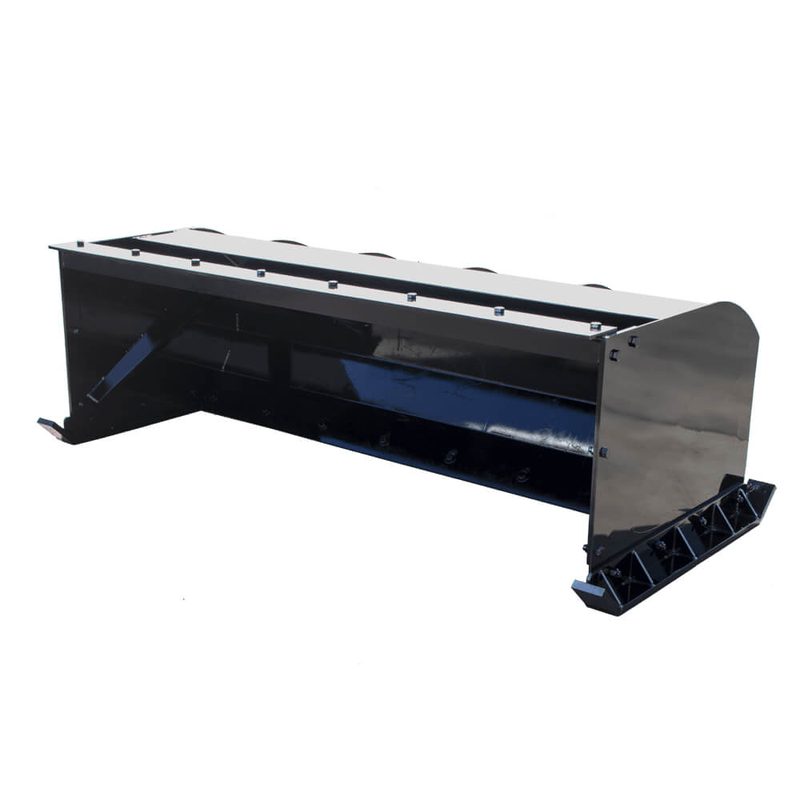
Here's the catch. A pusher doesn't make snow disappear. In deep or heavy snow, a long push can load the box faster than your skid steer can move it.
Once the tires spin or the tracks stop gripping, that extra width isn't helping much. You either shorten the push, take a smaller bite, or deposit the snow somewhere closer.
Before ordering, ask yourself two questions: How far is my longest push, and where can I unload it?
If you're drawing a blank on the second question, you may be shopping for the wrong attachment.
Plan your snow piles for more than the first storm, too. A spot that works in December might be blocking parking spaces or access routes by February.
Not every property needs an 8 or 10 foot commercial snow box.
The Storm Snow Pusher is an option for residential snow removal, acreage maintenance, farmyards, and shop approaches. Its 5, 6, 7, and 8 foot configurations make it worth considering where a heavier commercial pusher would be excessive.
The 5 foot Storm weighs 375 lb, while the 8 foot model weighs 525 lb. These weights are substantially below some of the heavier commercial pushers discussed later. You still need to confirm the mount, machine capacity, and intended use.
Now trade the parking lot for a 1,200 foot farm lane. It's narrow, there's a ditch on one side, and you need the route open before trucks start coming in.
With an angle plow, you can roll snow toward the open shoulder as you drive. You may need additional passes to open the full width, but you aren't carrying all that snow from the entrance to the far end.
Try the same run with a fixed snow pusher, and eventually you'll need to unload it.
If you're surrounded by trees or tall banks, finding a place to dump the snow becomes the job.
In a Tractor Basics comparison video, an operator described maintaining driveways exceeding 1,200 feet and preferring a plow on those long sections because a pusher would fill before reaching the end.
The useful lesson isn't a particular driveway length. Snow depth, machine size, terrain, and available dumping areas all affect how far a pusher can work before unloading.
Angle plows also make sense for curved lanes, narrow areas, and properties with islands, fences, or parked equipment.
A hydraulic snow plow lets you change the blade angle from the cab. That can be especially useful when you're working around obstacles and switching between left and right windrowing.
A manually adjusted angle plow can do the same basic job, but changing direction requires stopping and repositioning the blade.
Yard Patriots carries several skid steer snow plows and blades, including the Storm Snow Blade and the Prime Hydraulic Skid Steer Snow Blade.
There is a limit to windrowing, too. Once the banks along your road get high enough, you may run out of room to send additional snow. At that point, a bucket or snow blower can become necessary regardless of how good your snow plow is.
There's no reliable answer without looking at the property.
In a 2011 PlowSite discussion, an operator posting as cold_and_tired reported roughly 30% more production using a 9 foot pusher on a skid steer compared with a truck and plow equipped with wings.
That result and the Ford850 example above both favor pushers for their particular jobs. But they involve different machines and properties, not controlled tests. Neither should be treated as a universal productivity figure.
Now change the job to a long driveway with open shoulders. The angle plow's ability to windrow snow continuously can reduce the stops required to empty a loaded pusher. On that route, the snow plow may be the faster choice.
Commercial crews also use these attachments differently. A skid steer carrying a box pusher may gather large amounts of snow while another machine uses a plow to handle corners and windrows.
One operator in a PlowSite commercial snow removal discussion recommended a box pusher when the skid steer was the largest machine on the lot, but an angle plow when the skid steer was working alongside a larger loader.
How much time do you spend driving backward? How often do you handle the same snow twice? How far is the pile from the area being cleared?
Those answers tell you more than any universal acres per hour estimate.
This is where a lot of expensive buying mistakes start.
Ten feet sounds better than eight. Until a heavy snowfall turns that ten foot box into an anchor.
There's a rule of thumb that circulates among snow removal operators: approximately 1,000 pounds of machine weight per foot of pusher width.
DanofWI mentioned that guideline in a NewAgTalk discussion. It's operator guidance, not a manufacturer specification or a guaranteed machine match.
Actual performance depends on traction, attachment weight, machine capacity, cutting edge design, the snow itself, and the distance you're trying to push.
For example, a skid steer on ordinary lug tires may struggle with a pusher that the same machine could handle more effectively on dedicated snow tires. Operators have discussed exactly that difference when comparing 8 and 10 foot pushers.
Cutting edge design matters, too. Some operators have reported that sectional steel designs create less pushing resistance than continuous rubber edges in certain snow conditions. That doesn't make a larger sectional automatically suitable for a smaller skid steer. Attachment weight and the machine's rated capabilities still matter.
Operators have been describing this mistake for years.
In a 2014 PlowSite discussion, mach6353 described using a 12 foot pusher on an ASV tracked machine. It worked on short runs, but longer pushes made the machine work harder than he liked.
He went down to a 10 foot pusher.
There's a lesson in that experience. A wider attachment only saves time if your machine can move the load over the distance you actually need to cover.
Before ordering, think about the heaviest snow you normally get, how far you'll push it, the tires or tracks on your machine, and how much weight the attachment itself adds.
The right size isn't necessarily the widest attachment that will fit your quick attach plate.
Anyone who's cleared snow in the Upper Midwest knows six inches of powder and six inches of heavy, wet snow are two different jobs.
The difference is large enough that operators sometimes report their pushers handling deeper dry snow more easily than shallower wet snow.
For example, arrow, a Maine tractor owner discussing his setup on TractorByNet, reported using a 5 foot pusher on a 4,000 lb machine with loaded tires and ladder chains. He said 8 inches of wet snow could stop the tractor, while 15 inches of dry snow was manageable.
That's a tractor example, not a skid steer performance benchmark. It illustrates how dramatically the snow itself changes the load.
In a 2011 PlowSite discussion, cold_and_tired described his skid steer pusher as most effective in roughly 2 to 4 inches of snow for the length of his particular pushes.
With less than 2 inches, the box wasn't filling. With more than 4 inches, it filled before the end of the run.
That wasn't an attachment capacity rating. It was the operator identifying the most productive conditions for his property.
Another operator, amazingmaple, described using a 10 foot skid steer pusher successfully until the snow became heavy and wet. His approach was to take smaller bites or plow more often. Read the discussion on r/Skidsteer.
Likewise, krank described traction as the limiting factor when attempting full width pushes through wet or heavy snow in a Heavy Equipment Forums discussion.
Three practical adjustments help when conditions get difficult:
An angled snow plow can help by shedding snow sideways instead of carrying everything forward. But a heavy windrow can still create sideways resistance on slippery or sloped ground.
Weight, traction, appropriate tires, and operating technique matter as much as the engine's horsepower rating.
Two snow pushers can have the same working width and still be very different attachments.
Take Glacier's two product families. The 8 foot Glacier Heavy Duty Skid Steer Snow Pusher weighs 870 lb. The 8 foot Glacier Severe Sectional Snow Pusher weighs 1,500 lb.
That's a 630 lb difference before either attachment touches the snow. They may share a width, but they aren't interchangeable choices for the same machine.
5 ft: 375 lb
6 ft: 425 lb
7 ft: 475 lb
8 ft: 525 lb
Residential and property maintenance applications.
7 ft: 745 lb
8 ft: 825 lb
10 ft: 950 lb
Steel edge snow box for larger clearing jobs.
8 ft: 1,500 lb
Heavy commercial design for loaders, front end loaders, and large skid steers.
These are listed attachment weights, not the weight of a fully loaded snow pusher. They should be considered alongside the machine's rated capacity, operating weight, mount, terrain, and expected snow conditions.
A lighter attachment isn't necessarily the better attachment, either. The question is which design is appropriate for your machine and the work you need it to do.
The Glacier Heavy Duty skid steer pusher is available in 8 and 10 foot widths, with an adjustable rubber cutting edge, an integrated pullback bar, and replaceable wear shoes.
The Glacier Severe 48X60 is built for heavier commercial applications. Its 48 inch height, 60 inch depth, and substantial steel construction put it in a different category.
The Severe offers independent 24 inch AR400 steel cutting edge sections with a rubber trip system, along with a commercial rubber cutting edge option. Widths range from 8 to 20 feet.
Machine fit matters here: The Severe is intended for loaders, front end loaders, and large skid steers with appropriate mounting and operating capacity. A compatible attachment plate alone doesn't establish that your machine is suitable.
You've probably heard the argument. Rubber pushers don't scrape. Steel plows catch obstacles. Sectional pushers are the answer to everything.
Real snow removal isn't that tidy.
Rubber flexes over minor surface irregularities. That can help when the pavement has uneven transitions, raised utility covers, or areas where a rigid edge might be too aggressive.
It also has supporters on rough or mixed surfaces. In a discussion on r/Snowplow, Environmental-Dish92 recommended a rubber edge box pusher for extremely uneven surfaces and gravel.
That wasn't an endorsement of rubber over sectional equipment in general. In the same comment, the operator strongly favored Arctic sectional pushers for suitable paved surfaces. The recommendation for rubber was specific to rougher ground.
Rubber still isn't a guarantee against surface damage or displaced gravel.
On the other hand, rubber can struggle when vehicles have packed snow tightly against pavement.
In that discussion, bettywhitefleshlight described rubber edges as effective under favorable conditions but prone to smearing when conditions weren't cooperating. The commenter preferred metal edges for pavement and sectional designs for uneven paved surfaces.
Other operators have raised concerns about rubber wear when wet tire tracks freeze into ridges. IowaMark relayed that concern in a NewAgTalk discussion after talking with a snow pusher seller.
Rubber has its place. It just isn't the perfect answer for every surface.
Steel generally scrapes more aggressively on hard pavement and packed snow. That can be valuable for a busy commercial lot where traffic has compressed snow into the surface.
The concern is impact. A rigid steel edge can catch raised concrete joints, damaged pavement, or other obstacles.
Trip protection can help manage certain impacts, but operators still need to account for uneven surfaces and hidden hazards.
A sectional pusher divides its working edge into independent sections. Instead of forcing one long rigid edge across every high and low spot, individual sections can follow changes in the pavement.
The Glacier Severe is an example of this design, with independently tripping steel sections.

There's strong praise for sectional equipment among some commercial operators.
Optimal_Rate131, discussing sectional pushers used with Case loaders in southeastern Wisconsin, reported excellent ice scraping and good results around curbs while clearing commercial properties.
That experience is documented in a Reddit discussion comparing sectional pushers. The equipment described was being used on larger loaders, not a small skid steer.
There's another consideration for contractors maintaining commercial parking lots: what happens after plowing.
If a pusher leaves behind more packed snow or residue, the crew may need additional cleanup or deicing to get the surface into acceptable condition.
In the sectional versus box pusher discussion, bettywhitefleshlight noted that if you're salting afterward, the difference in scraping may not matter as much, but salt usage can climb as scraping performance gets worse.
Environmental-Dish92 reported a similar experience in a separate Kage Snowfire vs Arctic sectional discussion. The operator described using Arctic sectional pushers at several sites while also running a rubber edge pusher at a particularly rough location with gravel and railroad tracks.
According to that account, the Arctic scraped down to pavement more effectively, with noticeable differences in surface cleanliness and salt usage after storms.
The distinction matters for commercial buyers. An attachment's purchase price is only part of the cost of maintaining a property through winter. Additional cleanup passes, deicer usage, and labor can affect the overall expense.
There isn't a guaranteed savings percentage from switching equipment. Salt requirements still depend on pavement temperature, storm conditions, pretreatment, site standards, and the material being applied.
Start with the surface and the condition of the snow.
In a Reddit discussion about plows and pushers, jradke54 explained that a rubber containment edge could perform well on pretreated pavement, while a steel angle plow would be better suited to snow or ice already bonded to the surface.
A lot that was treated before the storm can behave very differently from one where vehicles have spent hours driving over untreated snow.
Think about how much scraping you actually need, how uneven the ground is, and what you're willing to trade between surface protection, wear, and cleanup.
On an unfrozen gravel driveway, either attachment can make a mess.
If the cutting edge digs in, you're moving driveway material right along with the snow. Come spring, you'll find that missing gravel in places you never intended to put it.
Skid shoes, cutting edge height, ground conditions, and operator technique all matter.
Some operators wait until the ground freezes and leave a thin packed snow base rather than scraping down into loose stone. Others rely on appropriate shoe settings and careful blade positioning.
One compact tractor owner, Bearcatrp, described regretting a pusher purchase because the attachment sank into an unfrozen dirt and gravel driveway. He shared the experience on OrangeTractorTalks.
No attachment is automatically gravel safe just because it has a rubber edge. The condition of the surface beneath the snow still matters.
Sometimes. But there's a difference between making an attachment more versatile and getting two jobs done equally well.
Suppose you maintain a long private lane that opens into a wide equipment yard. An angle plow makes sense for the lane, while a pusher would be handy for gathering snow across the yard.
Buying both might be difficult to justify if you're only clearing your own property. That's where combination equipment deserves a look.
The Storm Snow Blade Side Kit is designed for compatible Storm angle blades. The kit adds side plates to improve snow containment.
That can be appealing if you want to angle the plow on a driveway but use containment sides when clearing an open yard.
However, don't assume the sides can be used in every blade position or that changing configurations will always be convenient.
Confirm compatibility with your specific plow and how the completed assembly is intended to operate.
A hydraulic wing plow uses movable wings to change how the attachment handles snow.
Depending on the design, the wings can open for a wider clearing pass, move forward to help contain snow, or adjust to work around obstacles.
These attachments can be attractive to contractors working a mix of parking lots, driveways, and detailed cleanup areas.
The tradeoff is greater mechanical complexity, additional hydraulic or electrical requirements, and more components to maintain.
Not every wing plow operates the same way. Compare the manufacturer's available positions and controls before assuming one attachment can replace everything else.
For a contractor already operating multiple skid steers, this can be a straightforward solution.
One machine uses an angle plow to move snow away from corners, curbs, and islands. Another uses a pusher to gather those windrows and carry them toward the main snow pile.
An operator in a 2011 PlowSite discussion described using a skid steer with a blade for detail work and initial windrowing, while the pusher equipped machine handled the bulk snow and collected the windrows.
The plow handles direction and details. The pusher handles bulk snow movement.
If you're clearing one property with one skid steer, switching attachments may not be worthwhile. For a commercial crew working several different sites, having both tools can make sense.
Although this guide focuses on skid steers, many property owners use compact tractors with front end loaders or rear three point blades.
Don't assume the attachment recommendations transfer directly between those machines.
An angled front plow can generate sideways loading on a tractor's loader arms. A conventional pusher generally applies its force more directly forward, although it still needs to be properly sized and mounted.
George2615 raised this distinction in a TractorByNet discussion, noting that angled blades can put side stress on loader arms.
Its_in_neutral made a stronger warning about potential loader frame twisting in a Reddit tractor discussion, contrasting some tractor loader designs with skid steer mounting arrangements.
Those comments are operator opinions, not universal engineering rules. Loader construction, attachment mounting, structural support, and manufacturer approval determine what a particular machine can safely handle.
There is another side to the conversation. Arrow, a contributor on TractorByNet who identifies himself as a dealer, argued that compact tractors can use snow pushers when the attachment is properly sized. He pointed to oversized pushers as a common problem.
A rear blade is a different arrangement again. It attaches to a tractor's rear three point hitch rather than the front of a skid steer.
If you're shopping for a tractor, confirm the attachment and loader combination rather than applying skid steer sizing guidance to your machine.
Snow has an impressive habit of collecting right where you can't push forward: in front of a garage door, against a loading dock, or between parked equipment.
A pusher equipped with a proper pullback edge lets you drag snow away from the obstacle while operating in reverse, then turn around and push the collected snow toward the pile.
The Storm Snow Pusher includes a steel pull bar, with steel and rubber pull bar edge configurations listed on its product page.
The Prime Snow Box offers an optional bolt on backdrag attachment. It's a selectable option rather than standard equipment on every configuration.
Both are worth considering if you regularly clear around buildings, but check exactly what is included before ordering.
Sometimes neither a pusher nor a snow plow solves the real problem.
The lane is clear, but the banks keep getting taller. Or there's a fence on one side and a steep drop on the other.
You need to move snow away from the clearing path, not shove it into an even higher wall.
That's when the Prime Attachments Skid Steer Snow Blower is worth considering.
It discharges snow through a chute instead of building a pile directly in front of the machine. Suitable hydraulic flow and controls are essential, so confirm the skid steer's compatibility before ordering.

Forget the idea that the widest or most expensive attachment automatically wins. Start with the property.
The best attachment is the one that matches your usual work, not just the biggest storm of the year.
A snow pusher is usually the better choice for large open areas with a designated place to stack snow. A skid steer snow plow is usually better for long driveways, roads, and narrow lanes where snow can be directed toward the shoulder. Check machine compatibility and traction before choosing either.
They often do on open parking lots where containing snow reduces repeated cleanup passes. On long roads with room to windrow, an angle snow plow can be more efficient because it doesn't need to carry the entire snow load to the end of the route.
Usually nothing. Snow pusher, box plow, and containment plow are commonly used for the same type of attachment with side plates that keep snow contained while pushing it forward.
Yes. Skid steer snow plows are available with manually adjustable or hydraulically controlled angle functions. Confirm the mounting system, attachment weight, hydraulic requirements, and manufacturer compatibility before ordering. Browse our skid steer snow plows to compare the available options.
Start with your machine's operating weight, attachment capacity, traction, and the conditions you'll clear. Operators sometimes use a rough guideline of 1,000 lb of machine weight per foot of pusher, but it isn't a manufacturer specification. Verify the attachment and skid steer combination, and consider how far you'll push wet snow before unloading.
Snow pusher prices vary depending on width, weight, construction, and cutting edge design. These were the starting prices listed on Yard Patriots as of October 31, 2026:
Prices and configurations can change. Check each product page for current pricing and account for freight and optional accessories when comparing delivered costs.
Not automatically. A pusher carries accumulated snow in front of the machine, and deep, heavy snow can quickly overwhelm available traction. An angle plow sheds snow sideways but can also struggle with dense loads. Smaller bites and more frequent clearing can help both attachments.
Manual angle plows can be repositioned without auxiliary hydraulic power, but you must stop to adjust them. Hydraulic angle plows require compatible auxiliary hydraulics and controls. Check the specific attachment's requirements before buying.
Yes, with appropriate precautions. Cutting edges can dig into loose, unfrozen gravel, including rubber edges. Skid shoe settings, surface conditions, and careful operation all matter.
No. A rear blade usually refers to a tractor implement attached to the rear three point hitch. The snow plows discussed in this guide are front mounted attachments for skid steers.
Not necessarily. A snow bucket can scoop, lift, and relocate snow, while a pusher is designed to move snow along the ground without repeatedly lifting it. For large open areas with designated piles, a pusher may make bulk clearing more efficient.
Before buying, picture your worst routine snow day. Not just how much falls, but where you have to move it.
Can you make a straight push and leave the snow at the end? Or do you need it rolling off the side for hundreds of feet?
Answer that first. Then choose the attachment width, cutting edge, and mounting configuration your skid steer can actually handle.
A little time spent making that decision beats a winter spent wishing you'd bought the other attachment.
Browse our skid steer snow pushers and skid steer snow plows.
Or call or text 833-405-1700 with your machine model, surface type, and a description of the property. We'll help you narrow down the right attachment before it shows up on a freight truck.